
With less than six months left for this financial year and poor response from applicants, launching the scheme this year is unlikely.

Supply chains are evolving from operational backbones to strategic growth enablers for organisations, though they remain underleveraged and struggle for recognition at the executive level, a report by PwC India said. The survey highlighted that recent developments in the trade and tariff landscape represent both a stress test and a strategic inflection point for supply chains.

'We currently have new proposals worth Rs 1.48 trillion in the pipeline.'

The reduction in the number of loan accounts and the outstanding amount during the last financial year is a cause of concern and stress for microfinance institutions (MFI), Secretary, Department of Financial Services, M Nagaraju said on Thursday, highlighting "inefficiency" in MFIs that leads to higher rates of interest.

In its report, 'Asset Recovery Guidance and Best Practices', the global money laundering and terrorist financing watchdog, shared multiple examples from cases investigated by the ED, citing them as models of effective asset recovery practice and inter-agency coordination.

The ministries of Road Transport & Highways and Railways have exceeded the national average capital expenditure (capex) by spending 63 per cent and 57 per cent of Budget estimates (BE), respectively, in the first half of 2025-26 (FY26). The total capital expenditure for April-September of FY26 stood at 52 per cent of the BE, according to the latest data by the Controller General of Accounts (CGA).

IBBI removes sale of company as going concern in liquidation; now only asset sales allowed, shifting focus strictly to terminal liquidation process.

'The informal sector can grow at a 100 per cent rate -- we have to plan big.'

The Unified Pension Scheme (UPS) adoption rate has risen to over 4.35 per cent, with more than 100,000 people out of 2.3 million eligible individuals opting for it, Pension Fund Regulatory and Development Authority (PFRDA) chairman S Ramann said in an exclusive interview with Business Standard on Monday. He also said that six states had approached the PFRDA for help in adoption of the scheme.

By enabling real-time data sharing, the platform will help prevent scams and ensure secure transactions.

Both NDA and INDIA are racing to woo marginalised groups with Assembly polls fast approaching.

India needs to limit its reliance on multinational corporations (MNCs) for strategic audits and consulting in order to strengthen its economic sovereignty and achieve the goal of Atmanirbhar Bharat, the Ministry of Corporate Affairs (MCA) said in an office memorandum released on Wednesday.

Public sector banks (PSBs) have seen a sharp drop in household deposits from 70.6 per cent to 63 per cent in contrast with private banks, which witnessed a surge from 27.1 per cent to 34.1 per cent.

Businesses are testing new markets, tapping into domestic demand, and pushing the government for relief.

The 50 per cent US tariff on Indian goods pose a downside risk to growth but the impact is expected to be short-lived for the economy, and consumption demand could see an uptick after the new goods and service tax (GST) rates are implemented which could even offset the external uncertainty, Chief Economic Advisor (CEA) V Anantha Nageswaran reckoned on Friday.

'Money moves in a web of transactions and payment addresses keep changing for offshore companies, which requires heightened monitoring measures.'
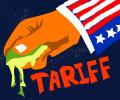
'If the near-term economic pain is absorbed more by those who have the ability and the financial strength to do so, then small and medium enterprises in downstream industries will emerge stronger from the trade imbroglio.'

'...as then it brings them closer to the complaints and grievances that the public faces.'

India's micro, small and medium enterprises (MSMEs) - which contribute over 45 per cent to outbound shipments - are facing a major disruption following the United States (US) decision to impose 50 per cent additional tariffs on the country's exports. MSME industry bodies have raised an alarm over the deep impact, seeking immediate government intervention.

The US' move to raise the tariff on most Indian goods to 50 per cent could drag India's GDP growth for FY26 by 35 to 60 basis points, according to various economists. One basis point (bp) is equal to 0.01 per cent.
 © 2026 Rediff.com - Investor Information - Advertise with us - Disclaimer - Privacy Policy - Sitemap - Feedback - About us - Terms of use - Grievances